
3 Life-Changing Tips for Parenting a Child with Sensory Processing Disorder
Hey there, fellow parent.
If you’ve landed here, I’m guessing you’ve spent countless nights scrolling through articles, trying to figure out why your child has such a unique way of experiencing the world.
Maybe they scream at the sight of a new sweater, or they can’t stand the hum of the refrigerator.
Perhaps they spin in circles for what feels like an eternity, or they have an intense, almost frantic need to touch everything.
You’ve probably heard the term **”Sensory Processing Disorder”** or **SPD** tossed around, and maybe it feels like a heavy label, a puzzle with a million missing pieces.
Trust me, I get it.
I’ve been in those shoes, feeling utterly lost and overwhelmed, wondering if I was doing something wrong.
But here’s the thing: it’s not your fault.
And it’s definitely not your child’s fault.
It’s simply how their brain is wired—a unique and beautiful, though sometimes challenging, blueprint.
Over the years, through trial, error, countless therapy sessions, and a whole lot of love, I’ve learned a few things that I wish someone had told me from the very beginning.
These aren’t just clinical facts; these are hard-won lessons from the trenches of parenting a child with **Sensory Processing Disorder**.
They’ve transformed our home from a place of constant anxiety and meltdown chaos into a haven of peace and understanding.
And I’m here to share them with you.
So, let’s take a deep breath together.
You are not alone on this journey.
And with a little bit of knowledge and a whole lot of compassion, you can empower your child to not just survive, but to thrive. —
Table of Contents
—
Understanding Sensory Processing Disorder: It’s a Matter of Wiring, Not Willpower
Before we get to the practical stuff, let’s talk about what’s really happening.
Your child isn’t being “difficult” or “dramatic.”
Their nervous system is simply interpreting and reacting to sensory information in a way that’s different from the majority of people.
Imagine you’re at a loud concert.
For most people, it’s an exciting, maybe even overwhelming, experience, but you can handle it.
Now, imagine that same concert, but every single sound—the bass drum, the guitar solo, the crowd’s chatter—feels like a physical assault, a jarring blast directly into your skull.
This is what it can be like for a child with **Sensory Processing Disorder**.
Their brain isn’t filtering out the unnecessary noise; it’s treating every single input as critically important information.
It’s a constant state of hyper-alertness, and it’s exhausting.
When you understand this fundamental truth, it changes everything.
The meltdowns aren’t tantrums; they are nervous system overload.
The picky eating isn’t stubbornness; it’s a genuine fear of textures and tastes.
The constant touching and fidgeting aren’t defiance; they are a desperate attempt to seek the sensory input their body craves.
And this is where our first tip comes in.
The goal isn’t to “fix” your child, but to understand their unique sensory needs and provide them with the tools and environment to meet those needs. —
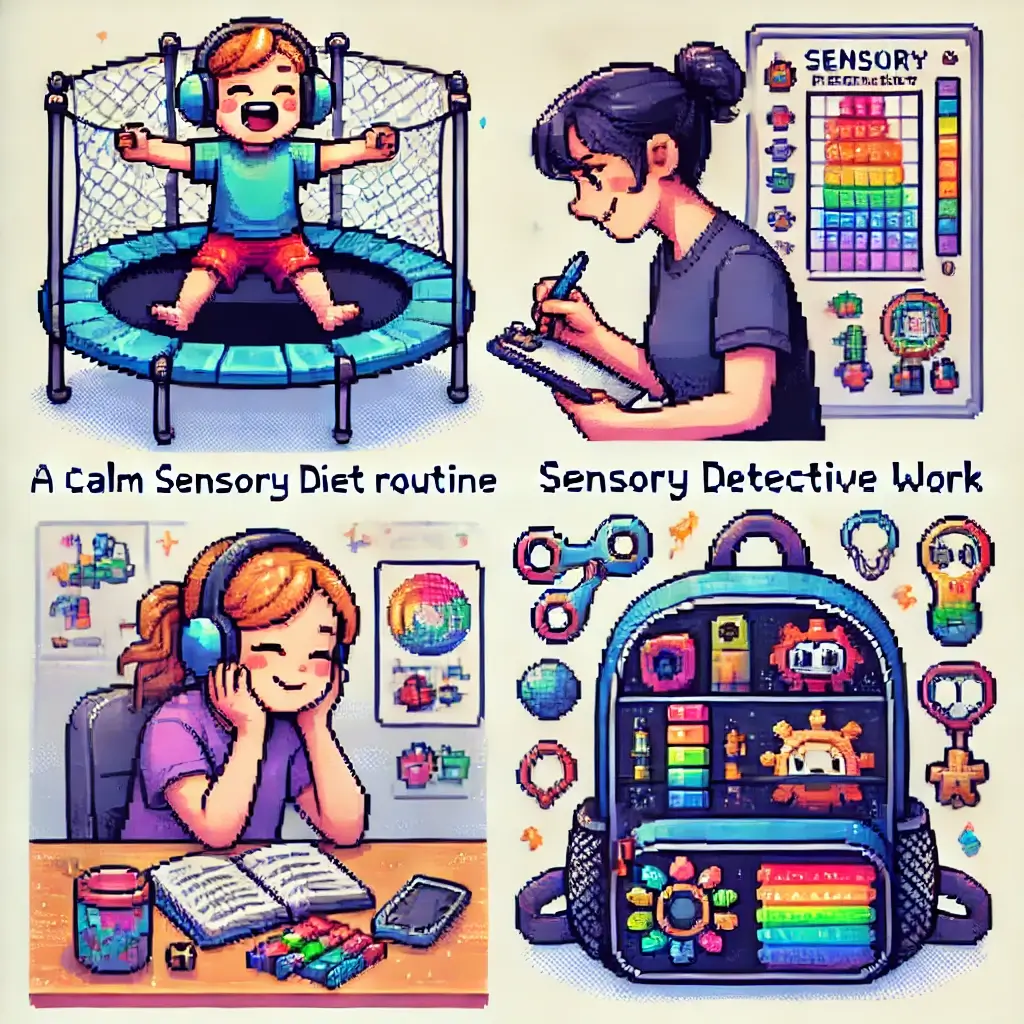
Tip #1: Create a Sensory Diet – Fueling Their Brain, One Sensory Input at a Time
The term “sensory diet” might sound a little strange, but think of it like a nutritional diet for the brain.
Just as our bodies need a mix of proteins, carbs, and fats to function properly, our nervous systems need a variety of sensory inputs to stay regulated.
A sensory diet is a carefully planned and scheduled set of activities that provides a child with the sensory input they need throughout the day.
It’s proactive, not reactive.
Instead of waiting for a meltdown to happen, you’re providing their brain with the “fuel” it needs to stay calm and organized.
This can be as simple as a series of activities you integrate into your daily routine.
For a child who is a sensory seeker, needing lots of movement and pressure, a sensory diet might include:
Jumping on a mini-trampoline for 5 minutes before school.
Pushing a heavy box of toys across the room.
Squeezing a stress ball during quiet time.
Wearing a weighted vest for 20 minutes in the morning.
For a child who is a sensory avoider, sensitive to light and sound, a sensory diet might include:
Using a dark, quiet “calm-down corner” with a soft blanket.
Listening to calming music with noise-canceling headphones before a busy event.
Doing a gentle activity like drawing or playing with playdough.
Wearing a hat to block out bright lights.
The key is to work with an occupational therapist (OT) to figure out what your child’s specific sensory needs are.
They are the absolute experts in this area.
Think of them as your personal sensory chef, helping you create the perfect menu for your child’s brain.
One of the biggest mistakes I made early on was trying to stop the behaviors.
I’d tell my son to “stop spinning” or “sit still.”
What I didn’t realize was that he wasn’t trying to be defiant; he was trying to regulate his nervous system.
Once we started a sensory diet, those behaviors didn’t disappear overnight, but they became less frequent and less intense.
He was getting the input he needed on his own terms, in a safe and predictable way.
The meltdowns became less about a sudden explosion and more about a gradual decline, which gave us the chance to intervene and redirect him with a sensory activity. —
Tip #2: Become a Sensory Detective – Cracking the Code of Triggers and Soothers
This one requires a bit of detective work, but it’s one of the most powerful tools you’ll ever have.
You need to become an expert on your child’s sensory profile.
This means observing them with a new set of eyes.
What sets them off?
Is it the scratchy label on their shirt?
The flickering fluorescent lights at the grocery store?
The overwhelming smell of a new place?
And just as importantly, what calms them down?
Is it a tight hug?
A specific song?
The soft, rhythmic swinging in a hammock?
I recommend keeping a small notebook or a note on your phone.
Whenever you notice a big reaction—positive or negative—jot it down.
It could be something like: “Meltdown at the park. Noticed he was covering his ears when the sirens went off.”
Or: “He seemed really calm and focused while playing with kinetic sand today.”
Over time, you’ll start to see patterns.
You’ll see that the fluorescent lights at the doctor’s office are a major trigger, but the dim lighting at the library is a soother.
You’ll realize that the feel of a wool sweater is an absolute no-go, while the soft, weighted blanket is his best friend.
This isn’t about avoiding all triggers forever.
That’s simply not possible in a world full of sensory input.
But it is about being prepared.
If you know a trip to the mall is going to be overwhelming, you can plan ahead.
Maybe you go during off-peak hours, or you bring noise-canceling headphones, or you schedule a quick, calming activity in the car afterward.
Knowing your child’s triggers and soothers empowers you to be proactive and to advocate for them.
It’s a game-changer.
For me, realizing that my son’s aversion to certain sounds wasn’t him being “uncooperative” but rather a genuine sensory issue was a huge lightbulb moment.
It shifted my approach from trying to force him into a situation to figuring out how to support him through it.
We started carrying a small “sensory kit” everywhere we went.
This brings me to my next, and perhaps most crucial, tip. —
Tip #3: Build a Sensory Toolkit – Your Personal Arsenal for Any Situation
This is the practical application of your sensory detective work.
A sensory toolkit is a small bag or box filled with items that can either provide a child with the sensory input they need or help them regulate when they are feeling overwhelmed.
Think of it as their emotional first aid kit.
What you put in it will depend entirely on your child’s specific needs, but here are some common items:
For the tactile seeker: A small container of kinetic sand or slime, a fidget spinner, or a textured ball.
For the auditory avoider: Noise-canceling headphones or earplugs.
For the oral seeker: A chewy necklace or a crunchy snack.
For the visual avoider: Sunglasses or a small cloth to cover their eyes.
For the child who needs deep pressure: A small, weighted lap pad or a stress ball.
The beauty of this toolkit is that it gives your child agency.
Instead of you constantly trying to manage their environment, they have the tools to manage their own nervous system.
We started with a small bag and let my son choose what went in it.
Giving him that control was a game-changer.
He felt empowered, not a victim of his environment.
And it became a fun, collaborative project for us.
We’d talk about what he might need for different situations, and it became a regular part of our routine.
This toolkit isn’t just for meltdowns.
It can be used proactively.
For example, if you’re going to be sitting in a restaurant waiting for food, you can pull out the fidget toy to help them stay regulated and focused.
Or if you’re in a loud, busy space, they can put on their headphones before the noise becomes overwhelming. —
SPD Explained: A Quick Infographic
Navigating Sensory Processing Disorder
Sensory Seeking
A child who constantly seeks out more sensory input.
- Behavior: Loves to jump, spin, touch everything.
- Why: Their nervous system is under-responsive and needs more “fuel.”
- Solution: Provide opportunities for safe, intense sensory input.
Sensory Avoiding
A child who actively avoids sensory input.
- Behavior: Covers ears, avoids hugs, picky eater.
- Why: Their nervous system is over-responsive and easily overwhelmed.
- Solution: Create a calm environment and use a sensory toolkit.
The Key to Success: Understanding and Support
It’s not about changing your child, but about understanding their unique sensory profile.
- Sensory Diet: Scheduled activities to keep them regulated.
- Sensory Detective: Observe and document their triggers and soothers.
- Sensory Toolkit: A portable “first aid kit” for sensory needs.
Frequently Asked Questions (FAQs) About Sensory Processing Disorder
I know you’ve got questions.
I had a million of them when we first started this journey.
Here are some of the most common ones I hear and my honest, parent-to-parent answers.
What is the difference between SPD and being “picky” or “sensitive”?
This is a great question and one that can be hard for friends and family to understand.
The biggest difference is the intensity and the impact on daily life.
Most kids can be picky eaters, but a child with SPD might have a genuine physical aversion to certain textures or smells, making it impossible for them to eat.
They might have a meltdown over a seam in their sock because it feels like a rock grinding against their skin.
It’s not a choice; it’s a neurological reaction.
Does SPD get better with age?
Yes and no.
The challenges don’t just “go away” on their own, but with early intervention and consistent therapy (especially occupational therapy), a child can learn to manage and regulate their sensory system.
They build coping skills and strategies that will serve them for a lifetime.
The goal isn’t to make them “normal,” but to equip them to navigate the world with confidence and competence.
How can I find a good Occupational Therapist (OT) who specializes in SPD?
This is probably the most important step you can take.
Start by asking your pediatrician for a referral.
You can also search online for pediatric occupational therapists in your area.
Look for OTs who have specialized training or experience with Sensory Integration Therapy.
Don’t be afraid to interview a few different therapists to find one who is a good fit for your child and your family. —
You Are a Superhero Parent
Parenting a child with **Sensory Processing Disorder** is a journey filled with unique challenges and incredible triumphs.
It requires a level of patience, creativity, and unconditional love that sometimes feels superhuman.
Remember to be kind to yourself.
You won’t always get it right, and that’s okay.
Some days will be hard, and you will feel exhausted.
But every time you stop to really listen to your child, to understand their unique world, you are giving them the greatest gift of all: the knowledge that they are seen, heard, and loved for exactly who they are.
Keep going.
You’ve got this.
Learn More about Sensory Processing Disorder at STAR Institute
Read About Sensory Issues from Child Mind Institute
Find an Occupational Therapist on AOTA
Sensory Processing Disorder, SPD, Sensory Diet, Occupational Therapy, Parenting
🔗 5 Remote Work Health Hacks to Avoid Burnout Posted 2025-08-20 06:32 +00:00 🔗 Chakra Balancing Meditations Posted 2025-08-20 06:32 +00:00 🔗 Remote Work Health: Escape the Sedentary Trap Posted 2025-08-20 05:14 +00:00 🔗 Seborrheic Dermatitis Guide Posted 2025-08-19 13:23 +00:00 🔗 Chronotype Hacks for Peak Productivity Posted 2025-08-19 13:04 +00:00 🔗 Financial Mistakes Healthcare Professionals Make Posted Unknown Date